24 Best Sofas For Small Living Rooms
For years, I have experimented with furniture configurations in small apartments and helped my friends fit a comfortable sofa into a small area. With all my experience of choosing a perfect sofa for a small living room, I can definitely tell which sofas are good for such rooms and which ones simply eat away all the space. This guide will offer you actual measurements, practical tips, and useful recommendations when buying a sofa.
And now, what is the best sofa for a small living room? The best sofas for small living rooms include loveseats, armless sofas, apartment sofas under 72 inches, sleeper sofas, and thin track arms, usually less than 36 inches deep and with exposed legs.
Stay tuned because I am going to talk about 24 different sofa types based on their size, shape, design, and some common mistakes which people make buying sofas for small rooms.
Why Sofa Size Makes Or Breaks A Small Living Room
What no one ever tells you is that the sofa is not just a piece of furniture that you sit on. It is the main visual focal point in your home and choosing the wrong one will transform your comfy home into a maze of furniture. Choose the right sofa, however, and you will make the best use of your 300 square feet apartment.
It is important to measure everything carefully before you fall in love with a particular sofa on the Internet. It is important for small rooms to choose sofas with smaller depth rather than smaller width since a difference of just 6 inches will give you extra walking space. This is important if your living room serves both purposes.
Below I am providing you with the description of 24 different sofa types sorted into categories.
Quick Reference: Sofa Dimensions By Room Size
| Room Size | Recommended Sofa Width | Recommended Depth | Best Sofa Type |
|---|---|---|---|
| Under 120 sq ft | 48–60 inches | Under 32 inches | Loveseat, armless sofa |
| 120–180 sq ft | 60–72 inches | 32–35 inches | Apartment sofa, sleeper |
| 180–250 sq ft | 72–84 inches | 35–38 inches | Track-arm, small sectional |
| 250+ sq ft (open concept) | 84–96 inches | 38+ inches | Modular sofa, curved sectional |
Loveseats: The Classic Small-Space Solution
Loveseats work because they do the one thing tight rooms desperately need — they stop eating space. A standard loveseat runs 52 to 60 inches wide, roughly two feet shorter than a full sofa, yet it still seats two people comfortably. That’s the whole appeal.
When shopping, look for tight-back cushions and tapered wood legs. This combo keeps the silhouette light instead of blocky. Pair it with a slim console table behind it, and you’ve created a natural room divider without losing an inch of walking space. Light neutral colors like oatmeal, greige, or soft blue help the piece recede visually, while a bold accent pillow adds personality without adding bulk.
Loveseats suit almost any style, from farmhouse to mid-century modern. They’re especially great in studio apartments where the sofa also acts as a room divider.
- Pick 1: Tight-back loveseat with tapered legs (54 inches wide)
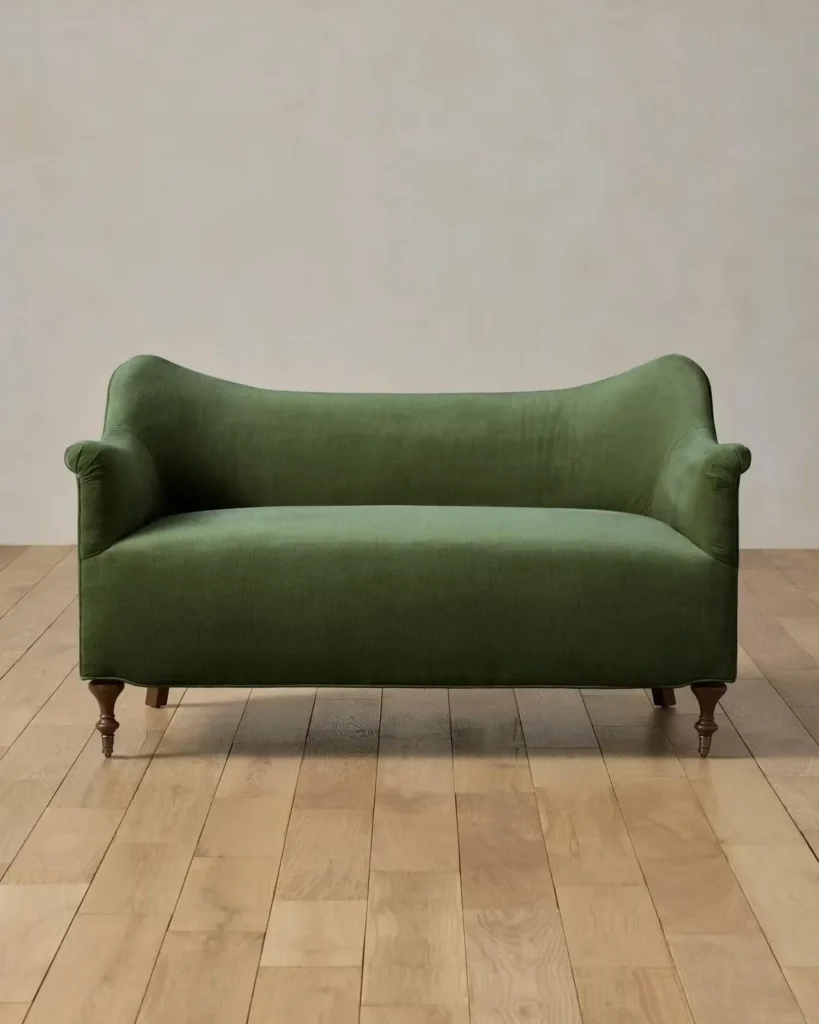
- Pick 2: Rolled-arm loveseat in performance fabric (58 inches wide)

- Pick 3: Tuxedo-arm loveseat with block feet (56 inches wide)

Next up, if you want a little more seating without going full-size, apartment sofas hit that sweet spot.
Apartment-Size Sofas: Full Comfort In A Smaller Footprint
Apartment sofas are the unsung heroes of small-space furniture. They’re built specifically to look and feel like a regular sofa, just trimmed down — usually 66 to 76 inches wide instead of the standard 84-plus inches.
The trick with these is proportion. Choose one with slim arms (under 6 inches) so more of the seat width goes toward actual sitting room. Stick to a low profile, around 30 to 33 inches in height, so the piece doesn’t tower over a small room. Slipcovered options in linen or cotton blends work beautifully here because they keep the look casual and airy rather than heavy.
These sofas fit traditional, coastal, and transitional homes especially well, since the classic silhouette doesn’t scream “small space compromise.”
- Pick 4: Slim-arm apartment sofa (68 inches wide)

- Pick 5: Slipcovered linen apartment sofa (72 inches wide)

- Pick 6: Low-profile track sofa (70 inches wide)

Now, if guests crash at your place often, you’ll want to look at sleeper sofas next.
Sleeper Sofas: Multi-Tasking Furniture For Guests
A sleeper sofa solves a real problem: where do overnight guests sleep when you don’t have a spare room? Modern sleeper sofas have come a long way from the lumpy pull-outs of the past. Many now use memory foam mattresses instead of thin coil inserts, so they’re actually comfortable.
Look for a twin or full-size sleeper if your room is under 150 square feet — queen sleepers need more clearance to open fully. Keep the fabric durable and stain-resistant since this piece works overtime. A performance velvet or crypton fabric handles daily use and occasional overnight duty without showing wear.
Sleeper sofas fit modern and eclectic homes particularly well, especially with a streamlined frame that doesn’t look like a “guest bed in disguise.”
- Pick 7: Twin memory-foam sleeper (58 inches wide)

- Pick 8: Full-size sleeper with track arms (76 inches wide)

- Pick 9: Convertible click-clack sleeper (66 inches wide)

For rooms where every single inch counts, armless sofas are worth a serious look.
Armless Sofas: Maximizing Every Inch
Armless sofas ditch the bulky side panels entirely, and that alone can save you 10 to 12 inches of width compared to a traditional design. That’s enough space for a side table or an extra person on the cushion.
I recommend pairing armless sofas with a textured throw and two accent pillows to keep the seat from looking too plain. Because there’s no armrest, choose a design with slightly deeper seat cushions (around 22 inches) so it still feels supportive and cozy, not like a bench.
These work incredibly well in modern and minimalist living rooms where clean lines are the whole point.
- Pick 10: Armless tufted sofa (64 inches wide)

- Pick 11: Armless modular loveseat (58 inches wide)

Speaking of modular pieces, let’s talk about small sectionals next.
Curved And Petite Sectionals: Cozy Corners Without The Bulk
Sectionals get a bad reputation in small rooms, but scaled-down and curved versions actually work wonders. A petite L-shaped sectional under 90 inches total can still create that wraparound coziness without dominating the room.
Curved sectionals, in particular, soften the sharp angles that make small rooms feel boxy. Place the chaise end facing a window or focal point, and keep the fabric in one continuous color to avoid visual clutter. Boucle and velvet curved sectionals have become popular because their soft shapes feel less like furniture and more like sculpture.
These fit beautifully in transitional and contemporary homes, especially ones with an open floor plan flowing into the kitchen.
- Pick 12: Petite L-shaped sectional (84 inches total)

- Pick 13: Curved boucle sectional (78 inches total)

- Pick 14: Reversible chaise sectional (88 inches total)

If flexibility is your top priority, modular sofas deserve your attention next.
Modular Sofas: Flexible Pieces That Grow With You
Modular sofas let you rearrange individual pieces as your needs change. Start with two armless chairs and a corner piece today; add another module later if you move somewhere bigger. This adaptability makes modular seating a smart long-term investment for renters especially.
Choose lightweight modules you can actually lift and rearrange solo — heavy modular pieces defeat the whole purpose. Stick to a single fabric type across modules for a cohesive look, and use one or two accent colors in pillows to tie everything together.
Modular sofas suit modern, Scandinavian, and eclectic spaces where flexibility matters as much as style.
- Pick 15: Two-piece modular loveseat set

- Pick 16: Three-module corner configuration

Let’s shift gears now to a style that’s all about clean, tailored lines.
Track-Arm Sofas: Sleek Lines For Tight Spaces
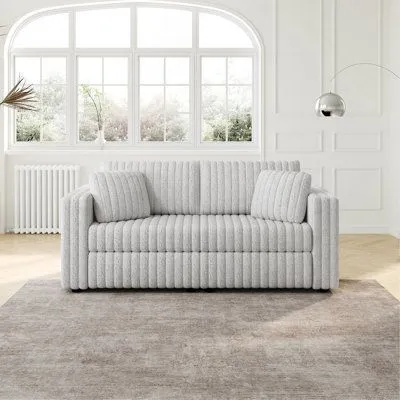
Track arms are thin, straight, and low — usually just 4 to 6 inches wide compared to the rolled arms on traditional sofas. That slim profile alone can free up several inches of usable seat width.
Because the silhouette is already minimal, I’d add texture through a bouclé or ribbed fabric so the piece doesn’t feel cold or sterile. Metal or wood peg legs complete the streamlined look and keep visual weight off the floor, which matters a lot in a small room.
Track-arm sofas are a natural fit for mid-century modern and industrial-style living rooms.
- Pick 17: Track-arm sofa with peg legs (70 inches wide)

- Pick 18: Track-arm loveseat in ribbed velvet (58 inches wide)
Now, for something with a bit more vintage charm, let’s talk settees.
Settees And Benches: Vintage Charm, Small Scale
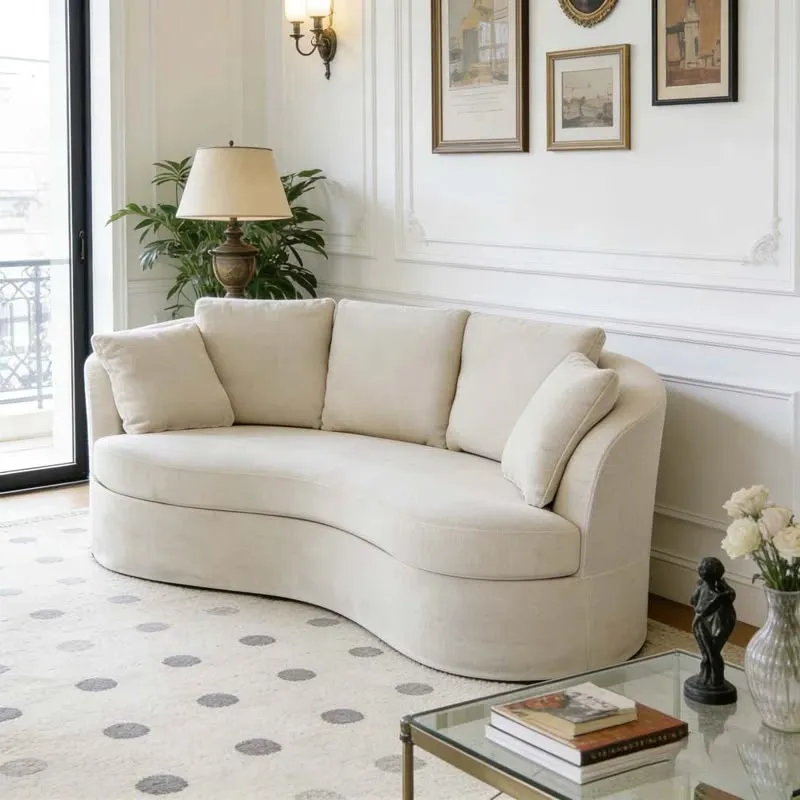
Settees are basically the great-grandparents of the modern loveseat, and they’re having a real comeback. Typically under 50 inches wide, they’re perfect as a secondary seating piece near a window or at the foot of a bed-turned-living-space.
Look for curved backs and exposed wood frames — these details add personality without adding bulk. A settee works best upholstered in a solid color, since busy patterns can look overwhelming on such a small scale.
These pieces are a dream for traditional, French country, and vintage-inspired homes.
- Pick 19: Curved-back settee (48 inches wide)
- Pick 20: Exposed-frame bench settee (46 inches wide)

If budget is tight, convertible sofas offer serious bang for your buck.
Convertible And Futon Sofas: Budget-Friendly Multi-Use
Convertible sofas fold flat into a bed, making them ideal for studio apartments or guest rooms doing double duty. They’re usually more affordable than dedicated sleeper sofas, though the mattress comfort varies a lot by brand.
Look for a metal frame instead of wood for better durability, and choose a removable, washable cover since these pieces see heavy use. Keep the color neutral so it blends into daytime living room decor and doesn’t scream “bed” when folded up.
These fit casual, bohemian, and studio-apartment style spaces particularly well.
- Pick 21: Metal-frame futon convertible (70 inches wide)
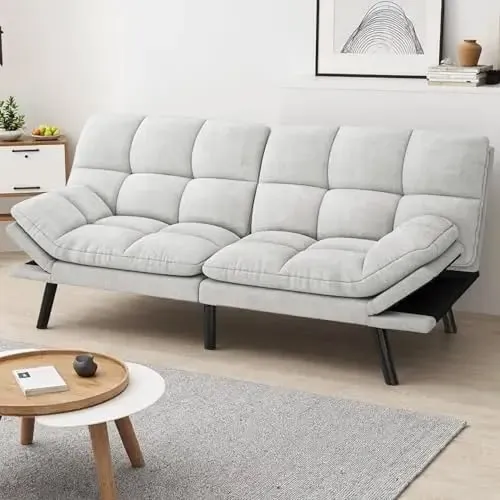
- Pick 22: Tufted convertible sofa bed (72 inches wide)

Last but not least, let’s wrap up with corner and slipcovered options.
Corner Sofas And Slipcovered Styles: Making Awkward Spaces Work
Corner sofas fill dead space that would otherwise go to waste, especially in rooms with an awkward nook or bay window. Slipcovered versions add an extra bonus: you can wash or swap the cover whenever life gets messy.
Measure your corner depth carefully before buying — many corner sofas need at least 32 inches of depth on each side to sit properly. Choose a slipcover in a durable cotton-linen blend for the best balance of comfort and easy cleaning.
These work wonderfully in cottage, coastal, and farmhouse-style living rooms.
- Pick 23: Corner-fit sofa with slipcover (82 inches total)

- Pick 24: Slipcovered bay-window sofa (80 inches total)

Tips For Success When Choosing A Small-Space Sofa
- Measure your doorways and stairwells before buying — not just the room itself
- Choose legs over skirted bases to create the illusion of more floor space
- Stick to one or two upholstery colors max to avoid visual clutter
- Prioritize depth reduction over width reduction when space is tight
- Test cushion firmness in person when possible; small sofas often use denser foam
Common Mistakes And How To Avoid Them
Buying based on room photos alone: Photos distort scale. Always cross-check actual dimensions against your floor plan.
Choosing dark, heavy fabrics: Deep colors can make a small sofa look even bulkier. Lighter, warmer neutrals usually work better in tight rooms.
Ignoring arm width: Two inches of arm width per side adds up fast. Slim or armless designs free up real seating room.
Overcrowding with accent pillows: Two to three pillows max on a small sofa — anything more eats into usable seat space.
Skipping the “walk-through test”: Before finalizing a purchase, tape off the sofa’s footprint on your floor and walk around it for a day.
Similar Variations Worth Considering
- Chaise-style loveseats for extra lounging without a full sectional
- Swivel chairs paired with a loveseat instead of a full sofa setup
- Daybeds as a sofa alternative that also functions as guest sleeping space
- Ottoman-and-loveseat combos for flexible extra seating that tucks away easily
Wrapping It Up
Finding the right sofa for a small living room really comes down to knowing your space and being honest about how you’ll use it. Whether you go with a slim loveseat, a curved petite sectional, or a budget-friendly convertible, the goal stays the same: comfort without the crowding.
I hope this rundown gives you a clearer picture of what to look for next time you’re shopping. With the right pick from this list of the best sofas for small living rooms, your tiny space can finally feel open, cozy, and totally yours.